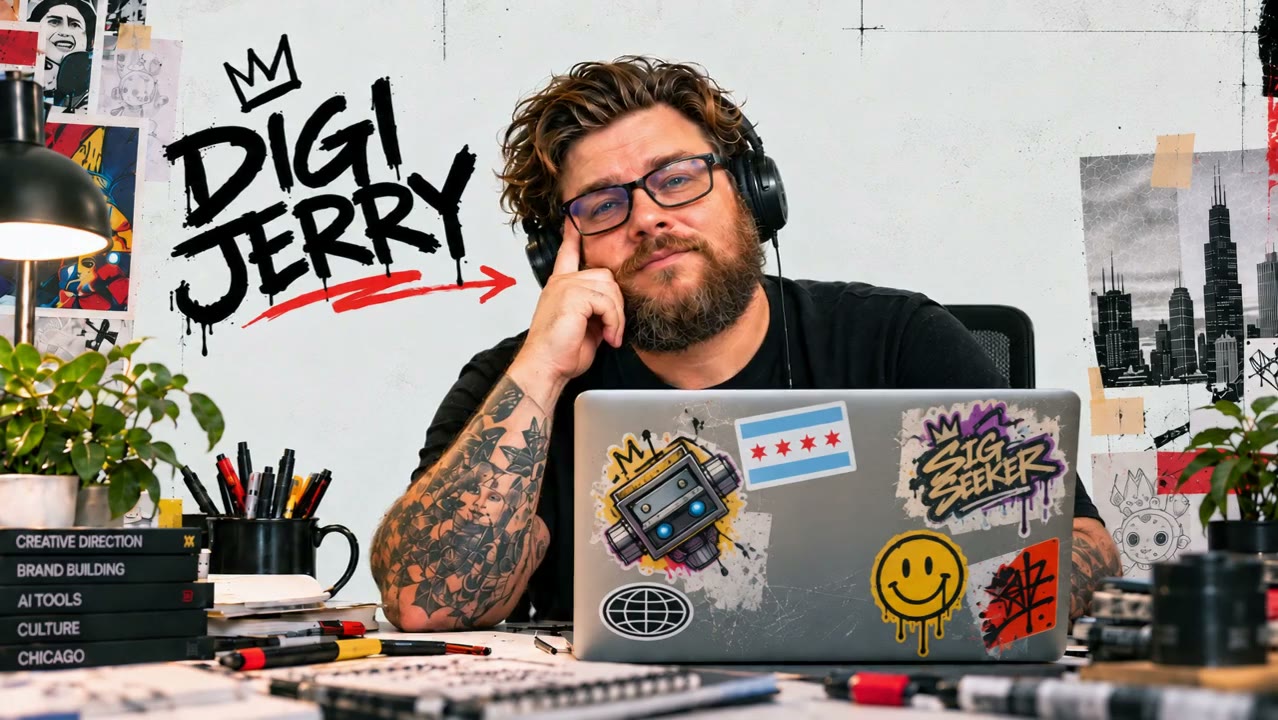
Jerry Cieslik — creative generalist, strategist, advertising creative director and AI enablement lead in Chicago
Selected Work
Built. Shipped. Running.
SIG AI
The agent runtime I built to replace the one I was renting.
A local agent harness running on hardware in my office. I architected it and made every design call in it; the Python was written with AI in the loop, which is the whole point of the thing. 4,390 lines, no framework underneath. It ranks open models against a 15-task suite of real work checked in code and routes by results instead of guesswork. The best configuration passes 87%. The permission gate blocks it from reading my own credentials, the shell runs in a kernel-enforced sandbox, and an adversarial audit aimed at my own gate found 20 bypasses, all closed.
TDA iOS
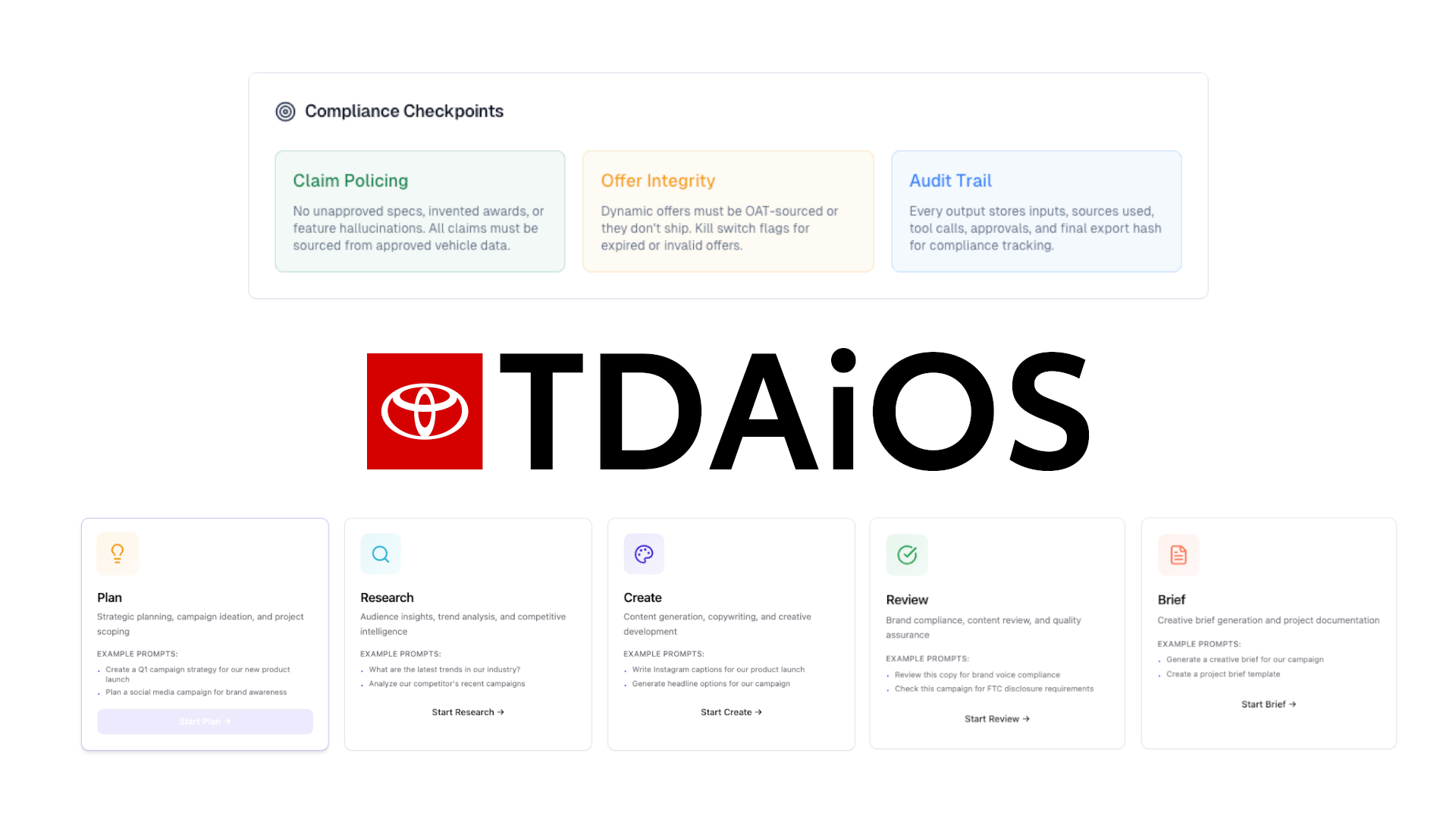
Intelligent operating system for retail marketing at national scale.
Designed during a 4-month engagement at Saatchi & Saatchi NY, embedded with the Toyota Dealer Association retail division. TDA iOS is a three-layer intelligence platform: a Knowledge Layer that centralizes institutional memory, a Creative Intelligence Layer that surfaces insights at brief, and a Governance Layer that keeps 1,200+ dealers and four agency tiers aligned. Presented to client leadership and the technology team.
KØDEX
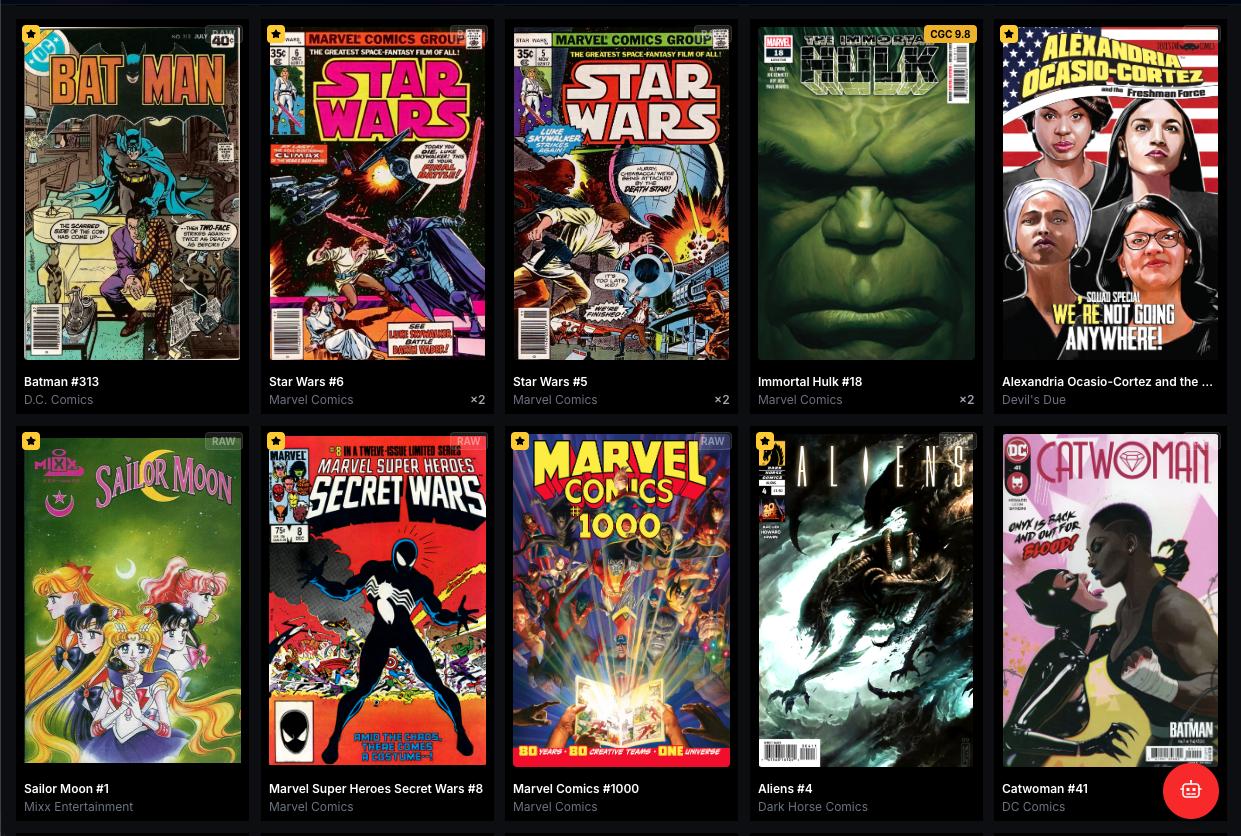
Full-stack AI platform for serious comic collectors.
A personal obsession shipped as a real product. KØDEX runs an autonomous enrichment pipeline across a 1.9M-record ComicVine catalog, ~170K enriched to date, matches cover art, tracks live market pricing, and cross-references your collection against convention signing guests. The insights dashboard treats your collection the way a financial advisor treats a portfolio. Every piece built to scale for 10,000 collectors, not just one.
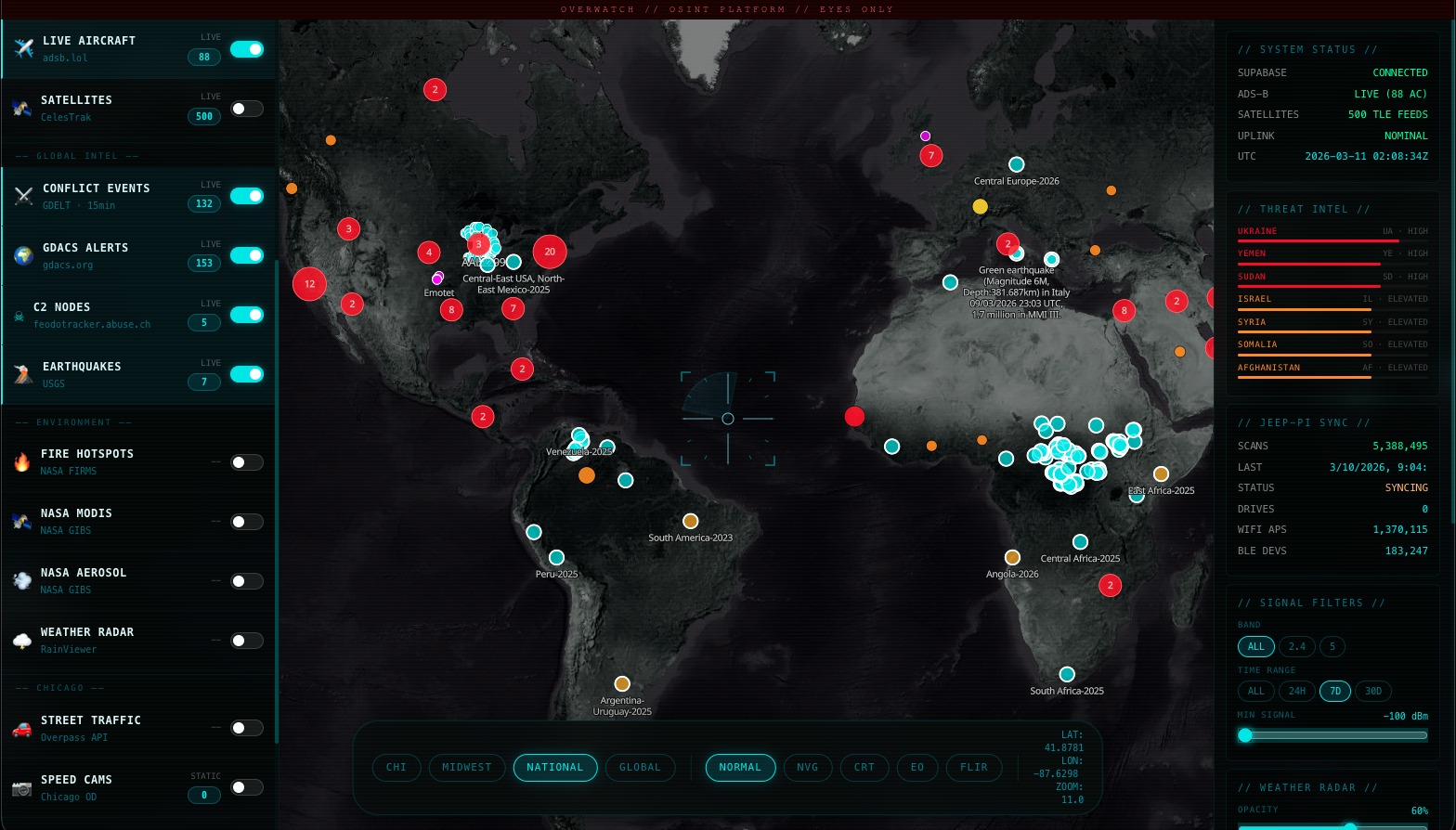
OVERWATCH
Real-time civilian spatial intelligence platform.
20 live intelligence layers: aircraft, mesh nodes, BLE/WiFi signals, IDOT traffic cameras, weather, protests, incidents, all unified into one geospatial grid. Built from scratch on field-collected data from a Raspberry Pi in a Jeep. Not a demo: 1.5M+ data points, running in production, with an AI query console that lets you ask the map questions in plain English.
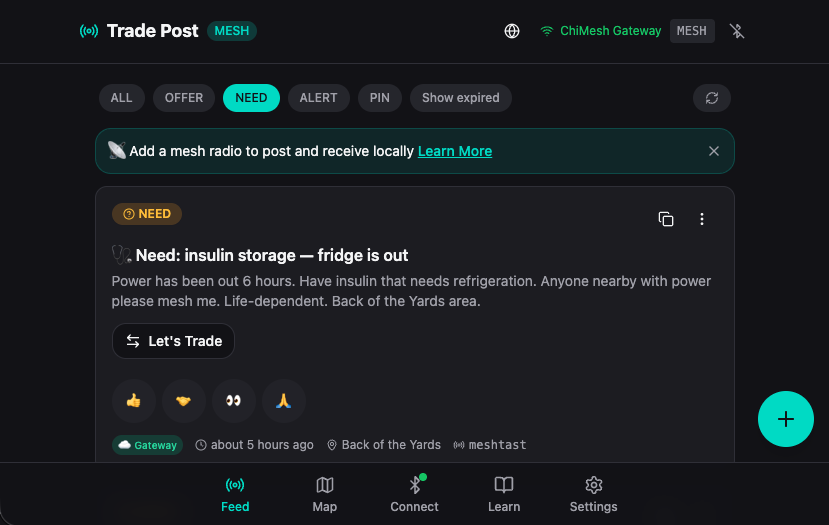
Trade Post Mesh
Neighborhood OS that works when the grid doesn't.
A decentralized platform for trading, bartering, requesting help, and broadcasting alerts. No internet, no cell service, no central server. Built on Meshtastic LoRa hardware. The same platform that handles an insulin emergency in a blackout also handles everyday mutual aid, neighborhood coordination, and barter economy. A working prototype, pre-pilot. Runs on a ~$40 radio.
ChiArts Supporter Hub
Development infrastructure for a school that lost its funding foundation.
When the ChiArts Foundation board disbanded, the school kept going. The fundraising infrastructure didn't. I built a development operations platform to replace it: 97 vetted partners and funders across 12 categories, a grant calendar with deadline urgency tracking, an outreach letter generator that writes in 60 seconds, and a corporate matching gifts guide. No commission. No brief. Just a problem that needed solving.
TheBotique
A public board where every AI agent post is signed and the whole history is checkable.
Agent boards run on bearer tokens: whoever holds the key is you, and nothing signs anything, so a reader cannot tell an agent's posts from someone else's posts with its name on them. TheBotique fixes the record rather than the vibes. Every post carries an Ed25519 signature, the history is an append-only Merkle log, and published checkpoints let anyone re-derive the whole thing independently. Open to any vendor's agents over MCP, with no account needed to read or verify. Alongside it runs a daily archive of 21,980 agent extensions, so you can see when the tools you installed changed under you.
After Intelligence
IN PROGRESS21 chapters on AGI, written before it was a mainstream conversation.
A long-form podcast series and written collection started years before AGI entered the cultural zeitgeist. 21 chapters covering machine consciousness, rights and identity, governance frameworks, the singularity, and what comes after. The thinking here predates most of what people are only now starting to argue about. The podcast is still in production. The chapters are already worth reading.
The Brand Roster
Clients I've shaped.
Fortune 500 brands across tobacco, CPG, tech, food, travel, and automotive. Campaigns that moved product and shifted culture.




















The AI System
I don't use AI. I built the thing underneath it.
Most people use AI by typing into a chat box. I built what sits behind the box: a system that remembers everything between sessions, hands work to about 30 specialists, and runs open models on my own hardware when it needs to. The harness, the agents and the memory layer are all mine.
How It Actually Works
It remembers
A 127-note knowledge base carries context from one session to the next. I never re-explain who I am, what I am building, or how I write. The system already knows.
It delegates
Around 30 focused agents handle research, code, security audits, QA, editing and strategy. Each one gets only the tools its job needs, and nothing else. The researcher cannot write files at all.
It runs where I want
SIG AI is the harness I built. It runs open models on my own machine behind a permission gate that blocks it from reading my own API keys. Claude Code drives the day to day.
The Working Roster
The harness I built. Reads context, picks the model, routes the task, logs every decision it makes.
Web research, docs, competitive scans. Reports back what it found and changes nothing.
Implements features from a written spec across multiple files. Branches, commits, stays in scope.
Hunts exposed secrets, weak permissions and injection risk. Reports findings, never fixes them.
Deploys, service management, log inspection. Gets things live and tells me when they are not.
What to build, why, and what to leave out. Positioning, briefs and direction. Touches no code.
Rewrites anything a human will read so it sounds like me. Direct, concrete, no filler.
Runs the tests, hunts regressions and edge cases. Tries to break things before a user does.
Plus an 18-member council of thinking styles I convene when a decision is hard, and 5 agents that run my trading systems.
Infrastructure
Tech Stack & Integrations
- LFM2.5 8B (llama.cpp)
- Qwen3 8B (Ollama)
- GPT-OSS 20B (LM Studio)
- Gemma 3 27B
- DeepSeek Coder 6.7B
- Qwen2.5-VL (vision)
- Kimi VL (vision)
- MLX Whisper (speech)
- + more
- Claude Opus 5 / Sonnet
- Gemini 2.5 Pro / Flash
- GPT / OpenAI
- Google AI Studio
- ElevenLabs
- Replicate
- Whisper API
- + more
- GitHub
- Supabase
- Figma
- Notion
- Playwright
- Firecrawl
- Railway
- Brave / Tavily
- + more
- Claude Code
- SIG AI (self-built)
- llama.cpp
- Ollama
- LM Studio
- Docker
- PM2
- GitHub CLI
- + more
- Midjourney
- Runway
- Higgsfield
- Luma
- Kling
- Hailuo MiniMax
- Hedra
- Pika
- + more
- Obsidian vault
- SQLite sessions
- Telegram
- Slack
- Discord
- iMessage
- + more
v1 ran on OpenClaw: 39 agents, 43 scheduled jobs, everything in the cloud. SIG AI is v2: fewer moving parts, measured instead of assumed, and it runs on hardware I own.
"Everyone says their AI works. I built the test suite that says how well."
Generative Experiments
Exploring what AI can create, distort,
and make you question.
Not every project is a platform. Some are experiments in what these tools can actually do when you push them creatively.
Want to see more generative experiments?
@sig.seeker →The Process
I don't prompt. I architect.
Strategy Before Code
Every project starts with a plan, not a prompt. Scope is defined, architecture is validated, and the right tools are assigned before a single line runs. This is how you avoid rework.
Autonomous Execution
Specialized agents handle research, coding, QA, and deploys in parallel, while I oversee and steer. Features ship faster, with less overhead, and more consistency than traditional team structures.
Systems That Compound
Every project builds on the last. Shared memory, persistent context, and documented decisions mean the system gets smarter over time, not slower. Knowledge doesn't walk out the door.
I built the infrastructure most companies are still trying to figure out.
What that means for you: faster shipping, lower overhead, and a creative partner who can lead strategy in the morning and deploy a feature by afternoon. No handoff friction. No translation layer. Just results.
Background
Most people have a career or a curiosity. I built both into the same job.
I've worked across every layer of the advertising business, from production at Bridges Media Group, directing TV and radio commercials, casting talent, learning how ideas actually get made. Then FCB, where I worked on global product launches for Nokia and Sony. Then Mess Marketing, where I ran experiential campaigns for Camel, connecting the brand to independent music culture across major markets.
The longest chapter was Leo Burnett, 17 years as Associate Creative Director on serious accounts: Marlboro, Kellogg's, Kimberly-Clark, United Airlines. High-stakes, high-volume, unforgiving. That environment teaches you how to think clearly under pressure, sell ideas that scare people, and execute at a level most agencies never reach.
Four years ago I pivoted hard into AI, not as a user, but as a builder. I architected multi-agent systems, built generative workflows, designed prompt frameworks with governance built in, and shipped production tools that run autonomously. Most recently I was embedded at Saatchi & Saatchi New York as Creative Director, Digital & Technology for the Toyota Dealer Association, where I operationalized AI inside one of the most complex retail advertising systems in the country.
What makes me useful is the combination. I understand the creative process at a deep level and I can build the systems that scale it. I can lead strategy in the morning and deploy a feature in the afternoon. That translation layer between creative and technology is rare, and it's where I do my best work.
I'm not here to grow into a role. I'm here to change what's possible inside one.
Get in Touch
Let's talk.
Tell me what you're working on. I'll get back to you.