Case Study · Trade Post Mesh
A Neighborhood OS.
No Internet Required.
Trade Post Mesh is a communication infrastructure and neighborhood operating system for barter, mutual aid, and local coordination, built to function without the internet. Trade goods, request help, post alerts, organize your block. It works over LoRa mesh radio when the grid is up, and keeps working when it isn't. Built on Meshtastic, end-to-end encryption, and OVERWATCH infrastructure intelligence. Currently a working prototype preparing for pilot deployment in Chicagoland.
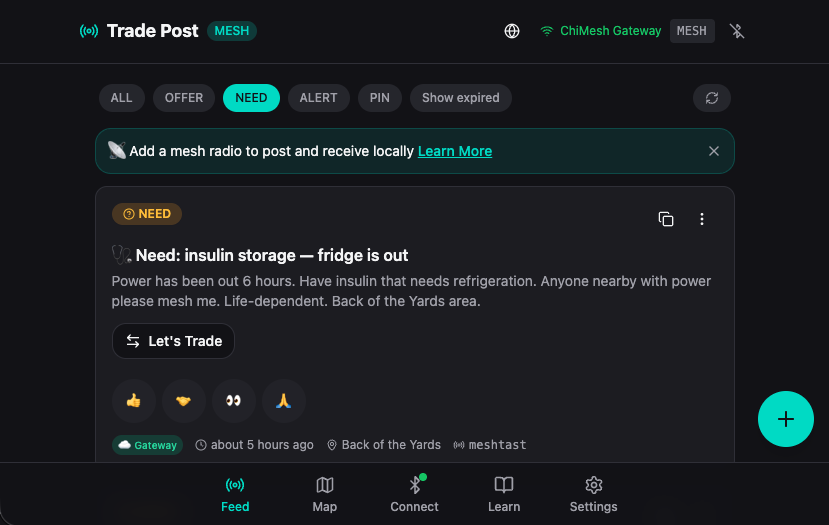
Live NEED post: power out, insulin needs refrigeration, Back of the Yards. No internet. No cell service. Neighbors still coordinating.
The Problem
Every platform built for neighbors assumes the grid stays on.
Facebook Marketplace. Craigslist. Nextdoor. Every tool built for neighborhood coordination routes through centralized cloud infrastructure. When the grid goes down (tornado, power outage, infrastructure failure) they disappear. During the exact moments when neighbors most need to find supplies, post safety alerts, request help, and coordinate exchange, the tools stop working.
But the problem runs deeper than disaster preparedness. Even on a normal day, local coordination is broken. Mutual aid networks run on spreadsheets. Barter happens through private DMs on platforms that take a cut. Community resources like tool libraries, shared gardens and skill exchanges have no shared operating layer. Neighbors are willing to help each other. The infrastructure to facilitate it doesn't exist.
Trade Post Mesh is that infrastructure. A neighborhood operating system for trade, mutual aid, and local coordination, built to work at full capacity when the internet is available, and to keep working when it isn't.
Neighbors are willing to help each other. The infrastructure to make it easy has never existed. Until now.
The Evolution
Started as an app. Became an operating system.
Trade Post
A neighborhood barter and coordination app. Post offers, post needs, browse listings, send messages. Cloud-hosted on Supabase. Standard client-server architecture. Solid foundation, but dependent on the internet to function.
Trade Post + OVERWATCH
Added the infrastructure intelligence layer. OVERWATCH measured real neighborhood signal density (WiFi, BLE, LoRa mesh nodes) and produced a 0–100 Neighborhood Readiness Index. Now the platform knew whether the local network could actually support peer-to-peer traffic.
Trade Post Mesh
The full vision, now a working prototype. Mesh-native transport activated by OVERWATCH intelligence. Offers, needs, and alerts broadcast through Meshtastic LoRa radio when the internet is down. E2EE payloads. Offline listing cache. Cloud becomes optional sync, not required infrastructure. Currently preparing for neighborhood pilot testing in Chicagoland.
What It's For
One platform. Many reasons to use it.
Disaster Response
When the grid fails (tornado, flood, ice storm, power outage) every cloud-dependent tool goes dark. Trade Post Mesh stays on. Neighbors can post alerts, request supplies, and coordinate mutual aid over LoRa radio without touching a cell tower or router.
Neighborhood Mutual Aid
A digital layer for the way neighborhoods already work. Post what you have. Find what you need. Coordinate locally without a middleman, a fee, or a platform that monetizes your data. Designed for the kind of reciprocity that already exists in tight-knit communities.
Barter and Local Trade
Cash-optional exchange for goods and services. Tools, food, labor, childcare, rides. Coordinate trades directly with neighbors. The mesh carries intent; settlement happens in person. No payment processor required.
Off-Grid Communities
Rural areas, intentional communities, event campgrounds, protest sites, festival grounds. Anywhere centralized internet is unavailable, unreliable, or politically compromised. Trade Post Mesh is the coordination layer that works regardless of grid status.
Community Infrastructure
Tool libraries, community gardens, maker spaces, mutual aid networks. Any shared resource that requires coordination between neighbors. Pin permanent nodes, publish availability, track who has what and what's needed. The platform scales from one block to a whole city.
Privacy-Critical Organizing
E2EE from the foundation. The server is intentionally blind. Location fuzzes to ±500m by default. No user tracking, no metadata leakage, no platform with access to what neighbors are trading or requesting. Built for communities where discretion is not optional.
The Architecture Shift
Cloud-optional. Not anti-cloud.
Transport
Peer-to-peer over LoRa, BLE, and WiFi
Messages travel device-to-device without touching a server.
Previously: Client to Supabase to Client
Connectivity
Offline-first. Cloud as memory, not dependency.
The app works when the grid is down. Cloud syncs when it comes back.
Previously: Internet required to function
Encryption
End-to-end encrypted. The server is blind.
Payloads are encrypted before they leave the device. Nothing in transit is readable.
Previously: Server-visible payloads
Mesh Activation
Conditional. Triggered by OVERWATCH readiness score.
The system knows when a neighborhood can support mesh and switches automatically.
Previously: Not possible
If you can do commerce without the internet, messaging is already solved.
The System
How it works, every day, and when it matters most.
Offer / Need / Alert Feed
The core coordination surface. Post what you have, what you need, or what the neighborhood needs to know right now. Posts are typed: OFFER, NEED, ALERT and PIN, each tagged with a node ID and set to expire. Browse without filtering noise from outside your area. When the grid is up, it syncs to cloud. When it isn't, the mesh carries it.
A real scenario: power out, insulin needs refrigeration, Back of the Yards. The app surfaces this to neighbors within mesh range. No internet required.
Mesh Transport via Meshtastic LoRa
Lightweight post intents broadcast over LoRa radio: the same long-range, low-power protocol used in disaster relief networks. No internet required for local propagation. Each post hops between mesh nodes, tagged with the originating node ID. The mesh doesn't replace the cloud. It activates when the cloud isn't there.
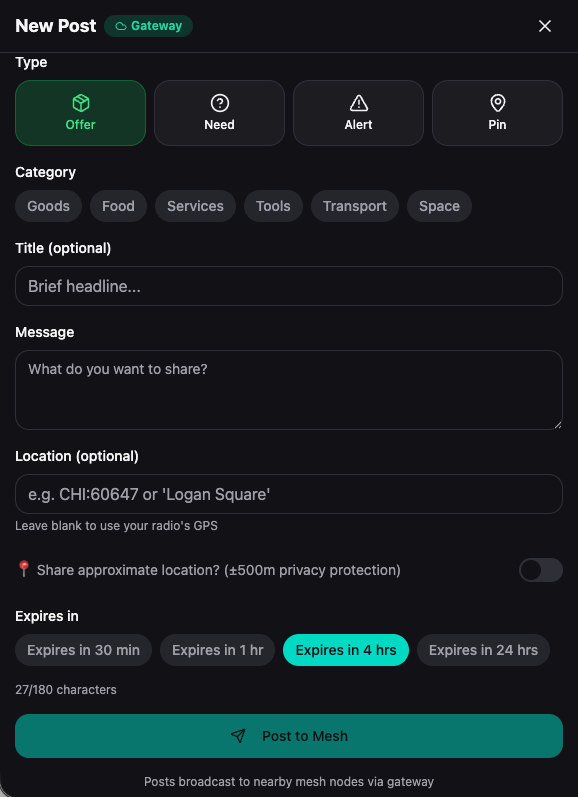
Post via Gateway or direct radio. Location privacy-fuzzes to ±500m by default. Posts travel peer-to-peer over LoRa when grid connectivity is unavailable.
E2EE From the Foundation
End-to-end encryption was designed in, not added on. Device key registration, Signal Protocol scaffolding, encrypted payload storage. The server is intentionally blind to offer content. Peer-to-peer mesh transport extends that property: payloads encrypted between devices, no relay decryption at any hop.
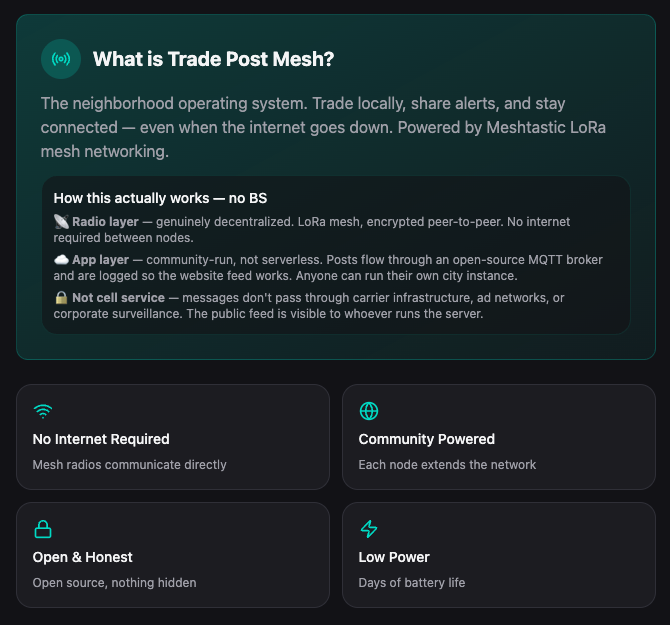
Three layers: the radio mesh, the app, and cloud sync. The server sees nothing it doesn't need to. Encryption is end-to-end at every transport layer.
OVERWATCH-Driven Mesh Activation
Mesh transport isn't always-on. It's conditional, activated when OVERWATCH reports sufficient BLE density, mesh node coverage, and redundancy for the local area. If the neighborhood can support it, offers route peer-to-peer. If not, the system uses cloud relay and flags the gap. Infrastructure viability drives transport selection automatically.
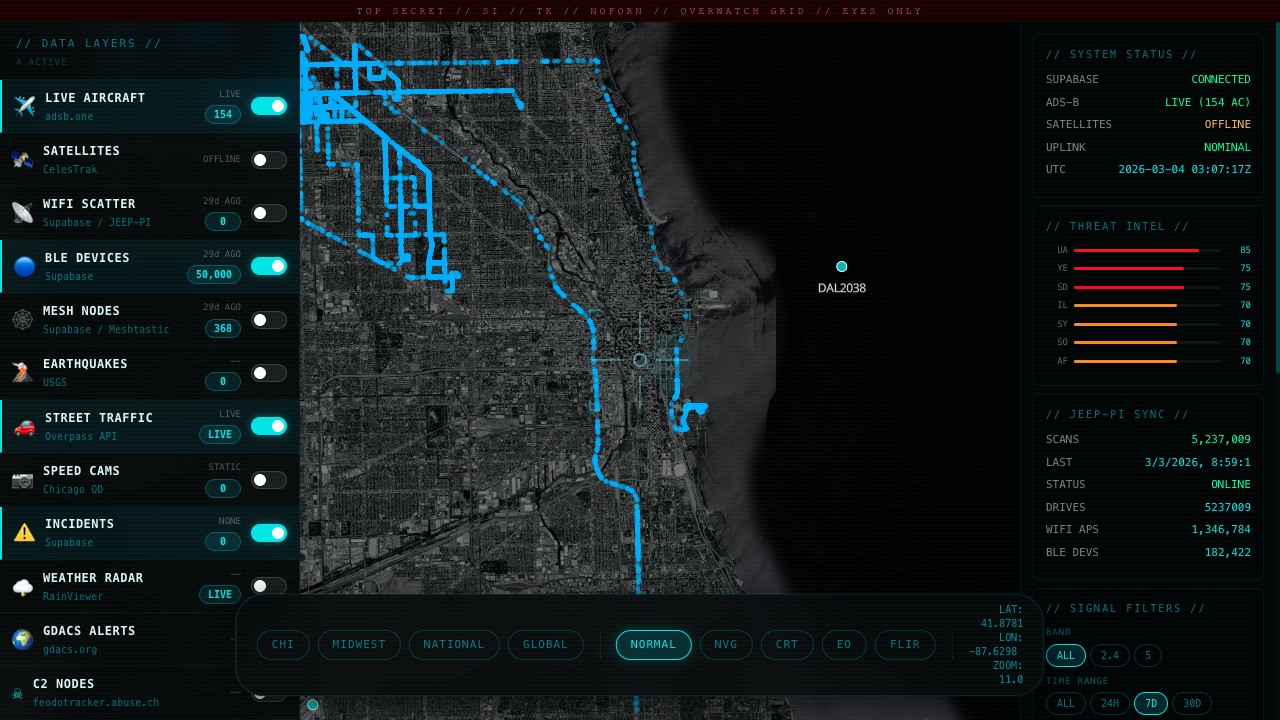
OVERWATCH: the intelligence layer underneath. Millions of scans, hundreds of mesh nodes, real-time readiness scoring tells Trade Post Mesh when to go peer-to-peer.
Neighborhood Map
Every post with a location appears on the map. Filter by type (offers, needs, alerts, pins) and see what's happening in each neighborhood at a glance. Tap any pin to expand the post. When mesh nodes are visible, the map shows their coverage radius so neighbors know where the off-grid signal reaches.
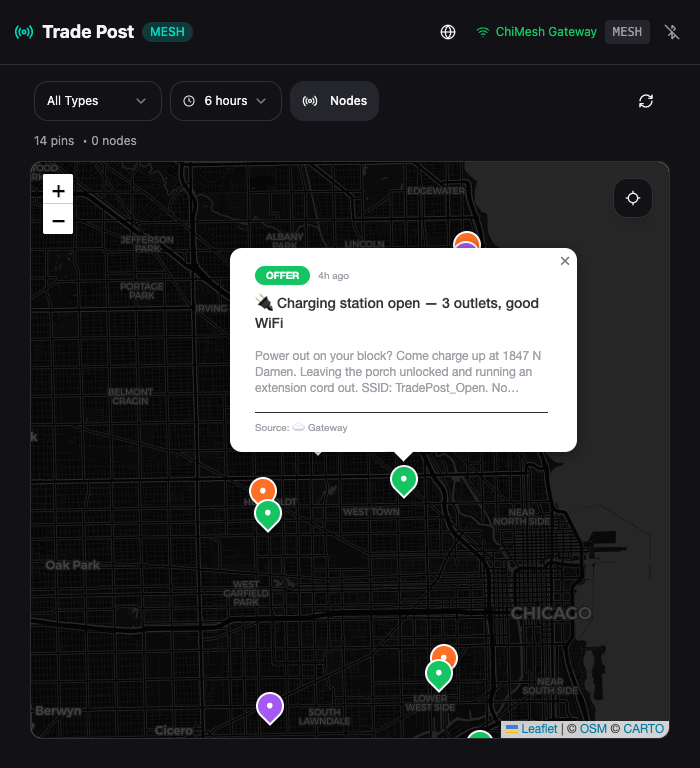
Live map of coordinated activity across Chicago neighborhoods. Colored by post type. Mesh node coverage shown as radius overlays when active.
Design Decisions
The thinking that made this different.
Start With the App, Then Earn the Mesh
Trade Post launched as a standard cloud app first, proving people would actually use a neighborhood coordination platform before building harder mesh infrastructure on top. The evolution to Mesh wasn't scope creep. It was the original destination, reached in the right order.
Cloud-Optional, Not Anti-Cloud
The ambition was never to eliminate cloud infrastructure. It was to stop requiring it. Supabase stays in the stack as secondary memory and sync. The shift is in what's required vs. what's preferred. Cloud becomes a nice-to-have, not a dependency. That's a fundamentally different architecture contract.
Economic Exchange as the Hard Use Case
Most mesh apps solve for messaging. Trade Post Mesh targets the harder problem: economic coordination. Matching offers with needs, propagating trade intent hop-by-hop, caching listings locally. Discovery and coordination travel over mesh, settlement syncs when the grid returns. If you can do commerce without the internet, messaging is already solved.
Built for the Worst Moment, Not the Average One
Every architecture decision was stress-tested against one question: does this work when the grid goes down at the exact moment the community needs it most? That constraint ruled out every conventional approach and forced the design toward something genuinely resilient.
The Hardware
You need a radio. That's the point.
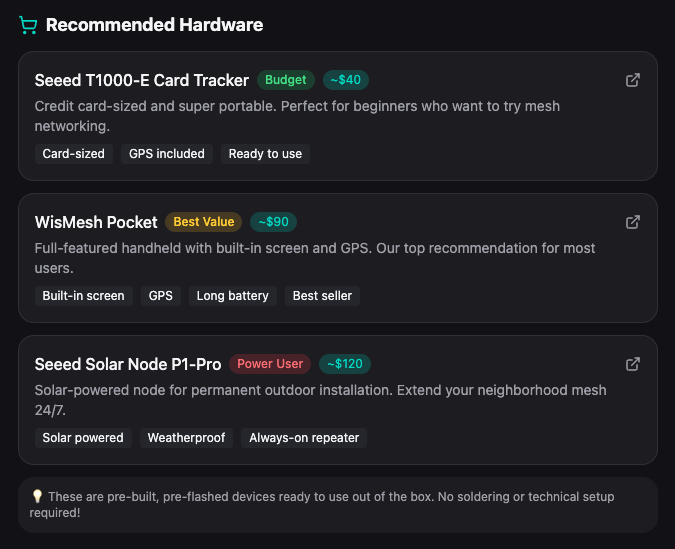
A small LoRa radio is what makes this system independent. No cell tower. No router. No monthly bill. Off-the-shelf Meshtastic devices start at $40, come pre-flashed, and work with Trade Post Mesh out of the box. The radio is the infrastructure, and you own it.
Concept Visuals
What it could look like in the wild.
AI-generated concept videos, made with OpenAI Sora. Experimental.
The Takeaway
A new category of platform.
Most platforms are built to extract value from local communities, taking a cut of every transaction, selling attention back to advertisers, centralizing data they don't need to hold. Trade Post Mesh inverts that model. No fees. No ads. No platform in the middle of what neighbors do for each other.
It's a working prototype today. It's an open infrastructure play tomorrow. The mesh network is already growing in Chicago through the ChiMesh community. OVERWATCH maps where coverage is strong enough to go fully peer-to-peer. The pilot neighborhoods are already identified. What's next is deployment, and proving this works at city scale.
The tools people rely on most disappear exactly when they're needed most. This one doesn't.